
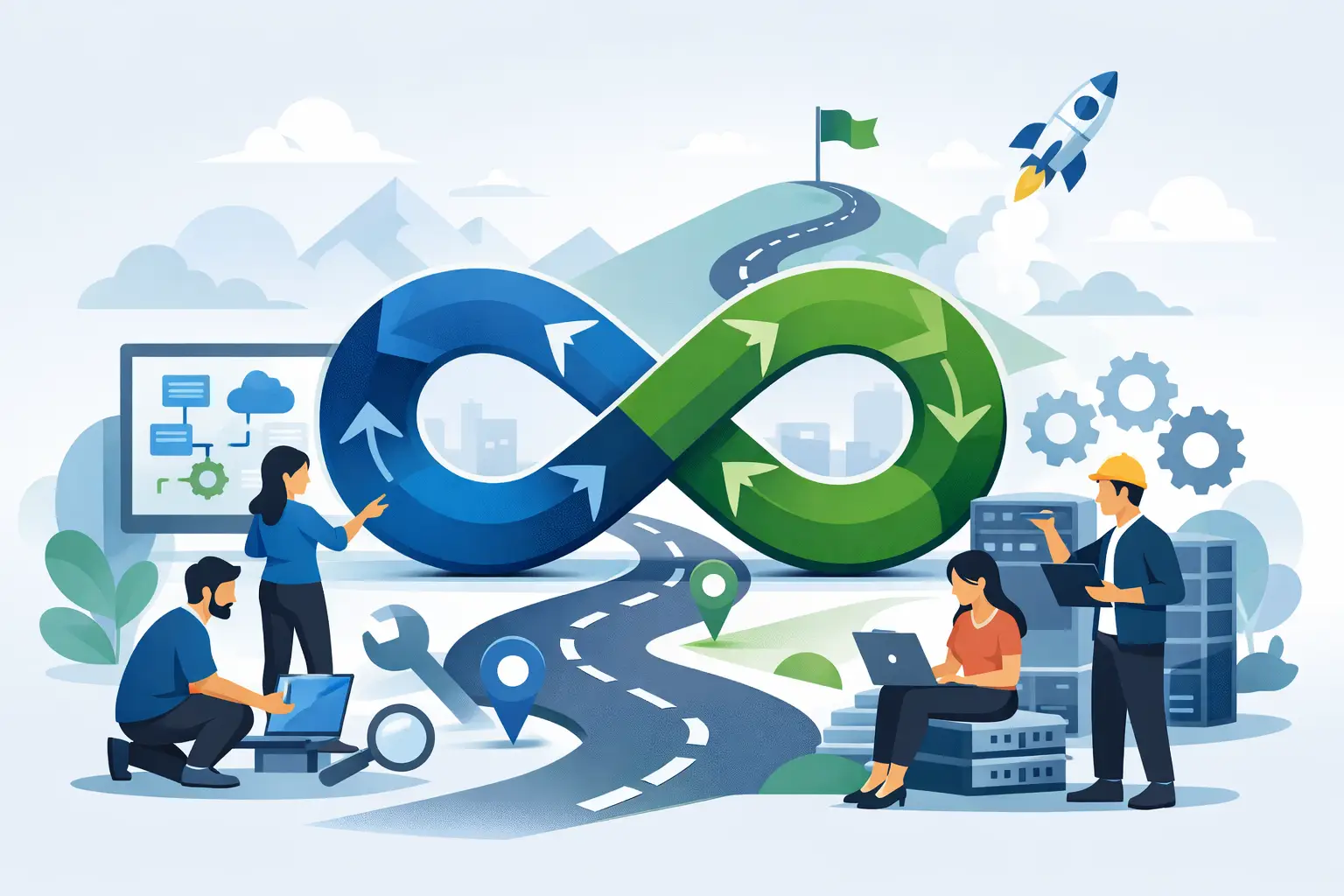
A DevOps program fails when it starts with a tool purchase instead of a delivery problem. If releases are unpredictable, environments drift, or production incidents repeat, this DevOps implementation roadmap guide provides a practical sequence for changing how software is built, tested, released, and operated.
The goal is not to copy another company’s platform. It is to create a delivery system that fits your product, risk profile, team size, and cloud footprint. A startup shipping weekly needs different controls than a regulated business operating critical customer systems.
Start With Delivery Baselines
Before redesigning pipelines or adopting infrastructure as code, establish a clear view of the current workflow. Follow one production change from planning through deployment and support. Measure where it waits, where it is manually handled, and where failures are discovered.
Look beyond deployment frequency. A team can release often while still creating operational risk. Useful starting measures include lead time from approved code to production, change failure rate, mean time to restore service, and the percentage of deployments completed without manual intervention.
This assessment should also identify constraints that are not technical. Approval chains, unclear ownership, separate development and operations priorities, and incomplete test data can slow delivery as much as an outdated build server. Treat these findings as design inputs, not team performance judgments.
A short baseline document should state the current release path, the highest-cost failure points, dependencies between teams, and the business outcome to improve. For example, reducing a two-week release cycle may matter because it delays customer commitments. Faster deployment is useful only when it supports a real business objective.
Define the Operating Model Before the Toolchain
DevOps is a shared operating model, not a handoff between development and infrastructure teams. Product engineering owns the behavior of its service in production. Platform and cloud engineers create secure, reusable paths for teams to deploy and operate that service. Security defines controls that can be tested and enforced early rather than reviewed only at the end.
Set ownership explicitly. Every production workload needs a named team responsible for its code, alerts, runbooks, dependencies, and recovery decisions. If no one owns an alert after business hours, adding more monitoring will not solve the problem.
Standardization matters, but excessive standardization can create a slower version of the old process. Standardize the parts that reduce risk and repeated effort: source control practices, build artifacts, identity controls, logging, deployment evidence, and environment provisioning. Leave room for teams to choose implementation details when the choice does not increase operational cost or security exposure.
Choose One Pilot With Real Value
Do not begin by migrating every application. Select a service that is meaningful enough to expose real constraints but contained enough to improve without a year-long program. A strong pilot has an active engineering team, a known release pain point, clear production ownership, and manageable integration complexity.
Avoid selecting the easiest internal application simply because it will produce a quick demo. A pilot that never encounters production approvals, secrets handling, database changes, or incident response will not validate the operating model. At the same time, avoid choosing the most business-critical legacy system first. The objective is learning with controlled risk.
Build the DevOps Implementation Roadmap in Phases
A useful roadmap sequences capability, not vendor selection. Each phase should deliver an improvement that teams can use immediately and measure in production.
Phase 1: Create a Repeatable Build and Test Path
Every code change should trigger a reproducible build. Store build definitions with the application code, version dependencies, and publish immutable artifacts. A build that works only on one engineer’s machine is not a delivery process.
Automated tests should reflect the risk in the application. Unit tests provide fast feedback, while integration and contract tests detect failures across services. End-to-end tests are valuable for critical flows, but an oversized suite can become slow and unreliable. Keep the test pyramid practical rather than ideological.
Include code quality checks, dependency analysis, and secrets detection in the pipeline. The correct threshold depends on the system. Blocking every low-severity finding can create alert fatigue; ignoring known exploitable vulnerabilities creates a different, more expensive problem.
Phase 2: Make Environments Reproducible
Manual environment configuration causes drift. Infrastructure as code gives teams a reviewable, repeatable way to create cloud resources, networking, access policies, compute, and managed services.
Start with the environment components that most often delay releases. For many AWS deployments, that means IAM roles, networking, container or compute configuration, database access, and secret management. Define separate environments using the same patterns, with intentionally different capacity and access boundaries.
Reproducibility does not require identical production-scale infrastructure in every nonproduction environment. Smaller environments reduce cloud spend, especially for startups and mid-sized teams. The trade-off is that performance and scale behavior must be tested deliberately before release rather than assumed from staging results.
Phase 3: Automate Deployment With Safe Release Controls
Once artifacts and environments are consistent, automate deployments. The pipeline should promote the same immutable artifact through each stage, record what changed, and stop when required checks fail.
Release safety is not limited to a rollback button. Use deployment patterns that match the service architecture and business risk. Feature flags can separate deployment from customer exposure. Canary releases can limit the blast radius of a change. Blue-green deployments can make reversions fast, though they may increase infrastructure cost and database migration complexity.
Database changes deserve their own discipline. Make backward-compatible schema changes where possible, deploy code that can handle both versions, and remove old structures only after the application no longer depends on them. A deployment pipeline cannot compensate for an irreversible data migration without a recovery plan.
Phase 4: Integrate Security and Operational Evidence
Security controls work best when they are part of the developer workflow. Scan infrastructure definitions before provisioning resources. Apply least-privilege access through managed identities and short-lived credentials. Centralize secrets rather than placing them in repositories, CI variables without governance, or application configuration files.
For systems with audit obligations, capture deployment evidence automatically: approver identity when required, artifact version, test results, infrastructure changes, and production release time. This is more reliable than assembling screenshots after an audit request.
Security reviews still matter for high-risk changes. The improvement is to focus human review on architecture decisions, data exposure, and exceptions, while routine policy checks run automatically on every change.
Phase 5: Operate Through Observable Signals
A production deployment is the start of accountability, not the end of engineering work. Teams need logs, metrics, traces, dashboards, and alerts tied to customer-impacting behavior.
Alert on conditions that require action. An alert should identify the affected service, likely impact, and first diagnostic step. If alerts are routinely ignored, reduce noise before adding coverage. Useful service-level indicators often include availability, latency, error rate, saturation, queue depth, and transaction success.
Runbooks should be short and current. For recurring incidents, document how to validate impact, mitigate safely, escalate, and verify recovery. Then use post-incident reviews to improve the system rather than assign blame. The strongest outcome is a change that prevents the same failure mode from returning.
Govern Progress Without Turning It Into Ceremony
A roadmap needs a cadence. Review progress monthly with engineering and business leaders using delivery and reliability data, not status updates alone. Ask whether releases are safer, recovery is faster, manual effort is declining, and customer commitments are easier to meet.
Expect trade-offs. A highly controlled approval process may be appropriate for a payment workflow but excessive for a low-risk content update. Full platform abstraction may help a growing organization, while a smaller team may benefit more from a focused pipeline and well-defined AWS account structure. The right level of investment depends on the cost of delay, failure, and operational complexity.
ZierTech approaches DevOps work as an execution discipline across cloud architecture, CI/CD automation, software delivery, security auditing, and AWS cost optimization. The sequence matters because isolated improvements often shift friction elsewhere.
Start with one production workflow, make the bottleneck visible, and improve the path teams use every day. A roadmap becomes credible when engineers can release with more confidence and leaders can see the operational result.