
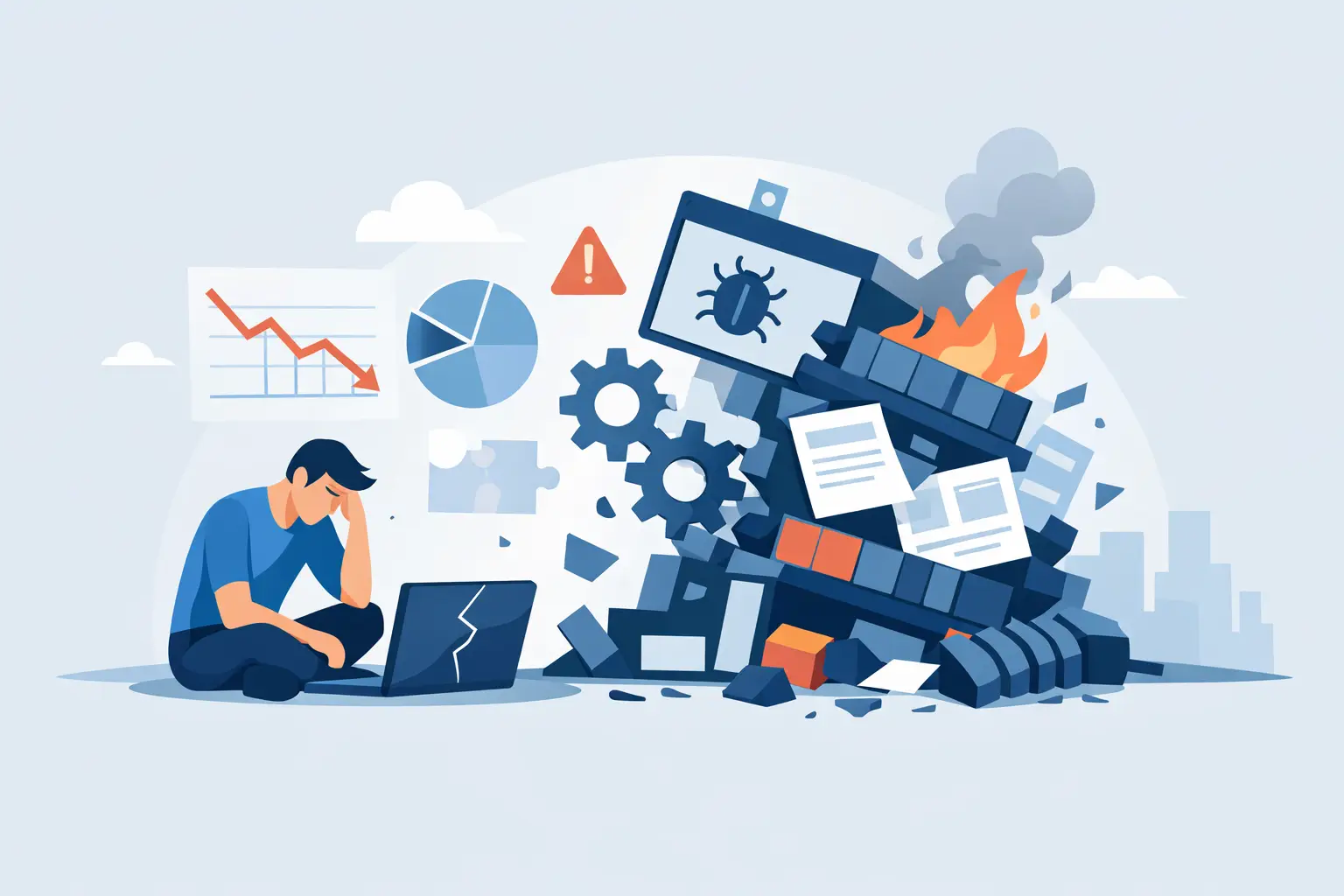
A project can look healthy right up to the week it misses launch. The roadmap is polished, the sprint board is active, and status updates still say green. Then reality shows up – timelines slip, scope changes pile up, confidence drops, and nobody can cleanly explain why. That is usually the real context behind the question, why do software projects fail.
The short answer is not bad code. Most failed projects do not collapse because engineers forgot how to build. They fail because the business case, delivery model, technical decisions, and operating discipline stop aligning. Software is rarely just a build problem. It is a coordination problem under uncertainty.
Why do software projects fail in the first place?
The common assumption is that failure starts in development. In practice, it often starts much earlier, during planning, budgeting, or executive expectation setting. Teams commit to a timeline before requirements are stable. Founders promise features before architecture is validated. Leaders approve budgets based on optimistic estimates instead of delivery constraints.
That early distortion compounds. Once a project is framed around an unrealistic deadline or an incomplete definition of success, every later decision becomes defensive. Teams cut discovery. Testing gets compressed. Documentation stays thin. Infrastructure decisions get deferred. What looks like momentum is often accumulated risk.
Software projects also fail because different stakeholders mean different things by success. A founder may want speed to market. Operations may want reliability. Finance may want cost control. Product may want flexibility. Engineering may want maintainability. None of those priorities are wrong, but when they are not reconciled early, the project becomes internally contradictory.
Failure usually starts with misalignment, not execution
When software delivery breaks down, many organizations look for a visible cause. They blame the vendor, the engineering manager, the backlog, or a missed sprint. Those can be contributing factors, but the deeper issue is usually misalignment between business intent and delivery reality.
A team cannot execute well against moving targets that were never properly defined. If the product vision changes every two weeks, velocity becomes noise. If leadership wants enterprise-grade security, real-time analytics, and custom integrations on a startup budget, quality becomes negotiable whether anyone says it or not.
This is where strong software auditing and technical planning matter. Not as bureaucracy, but as a way to expose mismatches before they become expensive. The earlier a team identifies architectural constraints, integration risk, or unrealistic assumptions, the more options it has.
Requirements that sound clear but are not
A surprising number of projects fail with requirements documents in place. The issue is not always missing documentation. It is vague language that creates false confidence.
Statements like “easy to scale,” “simple admin dashboard,” or “support enterprise users” sound reasonable until implementation begins. Then everyone discovers they had a different interpretation. Product thinks scalability means more users next quarter. Engineering hears multi-region architecture. Sales expects custom account structures. Security expects role-based controls and audit trails.
Ambiguity is expensive because it hides complexity until delivery is underway. At that point, changes are no longer conceptual. They affect schema design, cloud spend, QA scope, deployment processes, and release timing.
Stakeholder overload slows everything down
More input does not always produce a better product. In many organizations, software projects fail because too many people can redirect priorities without owning delivery consequences.
This creates a familiar pattern. Features are added to satisfy internal requests. Edge cases get treated like core functionality. Approval chains expand. Engineers spend more time waiting, clarifying, or reworking than building. The backlog grows, but product clarity gets worse.
The trade-off is real. Broad input can reduce blind spots, especially in regulated or operationally complex environments. But without clear decision rights, collaboration turns into drag.
Estimation failure is usually a business problem
Bad estimates are often framed as an engineering issue. They are not. They are usually the result of pressure to make a number acceptable before the work is understood.
A team asked for an estimate too early will either refuse, which is unpopular, or provide a range that gets converted into a commitment. From there, the project is measured against a fiction. Once dates enter board decks, investor updates, or customer promises, the plan becomes politically hard to correct.
This is one reason software projects fail even when teams are capable. They are working inside commitments that were never grounded in validated scope, system constraints, or delivery capacity.
A more credible approach is staged planning. Estimate discovery before estimating full implementation. Validate risk before promising deadlines. Treat unknowns as first-class factors, not inconveniences.
Technical debt is not the same as poor engineering
Technical debt gets blamed for almost everything, often without precision. Some debt is reckless. Some is strategic. The difference is whether the team understands the cost and has a plan to manage it.
Projects fail when shortcuts become permanent architecture. That often happens under schedule pressure. A team hardcodes workflows to hit launch. Infrastructure is provisioned manually instead of through repeatable DevOps practices. Security controls are postponed because there is “no time yet.” Monitoring stays basic, so incidents take too long to diagnose.
None of these decisions are fatal on day one. The problem is accumulation. Over time, change becomes slower, defects become harder to isolate, cloud costs drift upward, and deployment confidence drops. The system starts resisting the business.
For growth-stage companies, this is a critical inflection point. A product that was good enough for initial traction may be completely wrong for scale. That does not mean the original team failed. It means the operating model did not evolve fast enough.
Teams ship what the system allows
Talent matters, but process design matters more than many leaders want to admit. Good engineers inside a weak delivery system will still produce unstable outcomes.
If environments are inconsistent, releases become risky. If testing depends on manual effort, regression escapes increase. If infrastructure visibility is poor, incidents linger. If cloud architecture is inefficient, costs rise faster than usage. If nobody owns deployment readiness, launch dates become guesses.
This is where software development and DevOps discipline intersect. Delivery speed is not just about writing features quickly. It depends on deployment pipelines, environment parity, observability, rollback strategy, and operational ownership. Without those foundations, teams look slower than they really are because every release carries preventable friction.
Security gets treated as a late-stage check
Another reason software projects fail is that security is handled too late. Many teams treat it as a review step near launch instead of a design constraint from the start.
That approach works only when the product is simple and low risk. For anything involving customer data, regulated workflows, or third-party integrations, late security review creates painful rework. Authentication choices may be wrong. Access controls may be too broad. Logging may be insufficient. Infrastructure may not meet policy requirements.
Security auditing is most useful before a system is deeply committed to the wrong pattern. The earlier those issues surface, the cheaper they are to fix.
Adoption failure is still project failure
A software project can launch on time and still fail.
This happens when teams measure delivery but ignore adoption. The product meets the spec, but users do not change behavior. Internal teams keep relying on spreadsheets. Customers avoid the new workflow. Support tickets rise. Workarounds spread.
That kind of failure often points back to discovery. The team built what was requested, not what was actually needed. Or they underestimated change management, onboarding friction, and operational training.
For business leaders, this distinction matters. Shipping software is not the same as creating business value. If the system does not reduce cost, increase throughput, improve visibility, or create a better customer outcome, the project is underperforming regardless of launch status.
Why software projects fail less often in disciplined organizations
The difference is usually not charisma, headcount, or tooling. It is decision quality.
Disciplined organizations force clarity early. They separate assumptions from facts. They reduce stakeholder noise. They test architecture before scaling commitments. They use software auditing to identify structural risk. They treat DevOps as part of product delivery, not an afterthought. They review security before release pressure makes honesty difficult.
They also accept trade-offs. A faster launch may mean narrower scope. Greater flexibility may require a higher engineering investment. Lower cloud costs may mean reworking architecture. Better reliability may slow feature velocity for a period. Mature teams do not pretend those tensions are avoidable. They manage them directly.
That is the practical answer to why do software projects fail. Not because software is uniquely chaotic, but because many organizations try to run a technical delivery effort with unclear priorities, weak controls, and unrealistic promises.
A better project usually starts with a simpler question: what problem must this system solve, and what are we willing to trade to solve it well?