
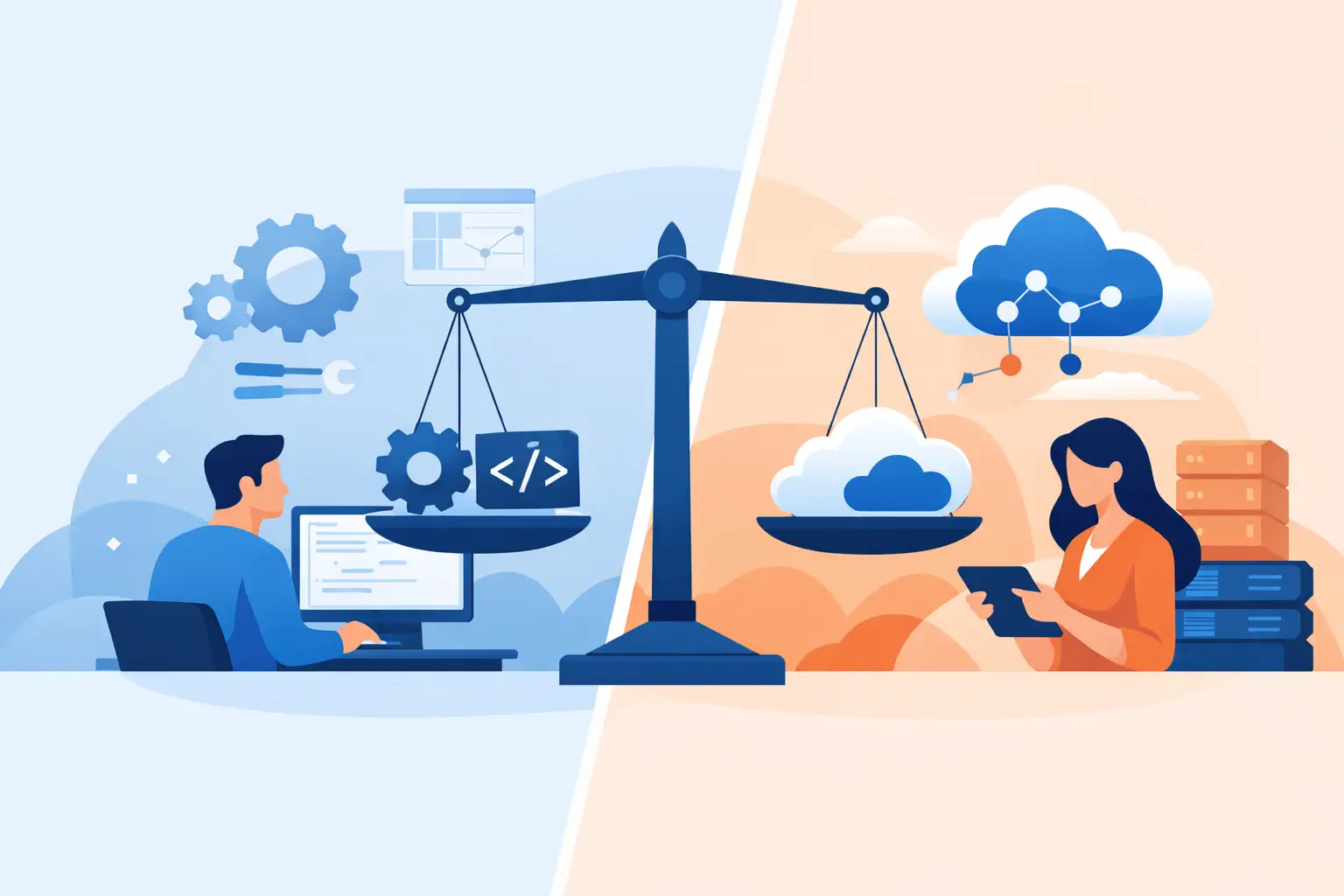
A team outgrows its tools in small ways first. Reporting takes too long. Workarounds become policy. One department pays for features nobody uses while another still relies on spreadsheets. That is usually when the real custom software vs SaaS decision starts – not at launch, but when the business begins to feel the limits of its current stack.
For founders and operators, this is rarely a pure technology question. It is an operating model question. You are deciding whether to adapt the business to a product you rent, or invest in software shaped around the way your company actually works.
Custom software vs SaaS: the core difference
SaaS gives you a ready-made application delivered by a vendor. You subscribe, configure what you can, and start using it quickly. The vendor owns the roadmap, infrastructure, maintenance cycle, and most of the technical decisions.
Custom software is built for your business requirements. That could mean an internal operations platform, a customer-facing product, or a workflow system that connects multiple tools and data sources. You control what gets built, how it integrates, and how it evolves over time.
Neither model is automatically better. The right choice depends on how standard or specific your needs are, how much control matters, and whether software is simply supporting the business or actively creating advantage.
When SaaS is the right call
SaaS works best when the problem is common and the value is speed. If your team needs CRM, accounting, help desk operations, email automation, or project management, there is usually no business case for building from scratch. These categories are mature, widely understood, and already optimized by vendors serving thousands of companies.
The immediate benefit is time. You can deploy quickly, avoid a long development cycle, and get predictable pricing. For startups and lean teams, that matters. Capital stays available for areas that directly affect growth, product differentiation, or customer experience.
SaaS can also reduce internal engineering overhead. You are not responsible for maintaining feature parity, fixing every bug, or planning infrastructure for a non-core system. In many cases, a well-chosen SaaS platform is the most efficient answer.
But efficiency has a ceiling. Once your processes become more specialized, SaaS often starts pushing your business toward its assumptions. That is fine if the software reflects best practice. It becomes a problem if the software forces expensive workarounds or creates friction between teams.
When custom software makes more sense
Custom software becomes viable when your workflows are central to performance, margin, compliance, or customer experience. If the way you operate is meaningfully different from off-the-shelf assumptions, building can make more sense than forcing alignment with a product that was designed for everyone.
This is common in operations-heavy businesses, platform companies, logistics workflows, regulated environments, and multi-system environments where data must move cleanly across teams. It is also common when leaders need visibility that existing tools cannot deliver without manual effort.
The strongest case for custom software is not preference. It is leverage. If a custom system removes repetitive labor, reduces errors, improves decision speed, or creates a better user experience, the economics can shift quickly in its favor.
There is also a control argument. With custom software, your roadmap is not tied to a vendor’s priorities. You decide which features matter, which integrations are required, and how security or cloud architecture should be handled. For some businesses, that level of ownership is strategic, not optional.
Cost is not as simple as license vs build
Many comparisons reduce the issue to upfront cost versus subscription cost. That framing is too shallow.
SaaS usually wins on short-term affordability. You can start with a monthly or annual subscription, avoid a large initial build, and shift spend into operating expense. That lowers risk early on. It also makes procurement easier for many teams.
Over time, though, SaaS costs can compound. Per-seat pricing rises with headcount. Premium tiers gate important features. Integration costs increase. Teams adopt adjacent tools to fill product gaps. What looked cheap at 20 users may look very different at 200.
Custom software has the opposite profile. The initial investment is higher because you are paying for product design, engineering, architecture, testing, and deployment. But once the system is live, your cost structure changes. You are no longer paying for broad feature bundles built for other companies. You are funding a system that serves your specific use case.
That does not mean custom software is cheaper. It means the cost curve is tied to your business logic rather than a vendor’s packaging. For companies with stable, high-value workflows, that can be a better long-term fit.
Speed now versus fit later
One reason SaaS keeps winning is simple: businesses need answers fast. A platform that can be deployed in days often beats a custom build that takes months.
That speed matters most when requirements are clear, standard, and unlikely to change much. It also matters when the company is still learning what process should exist. Early-stage teams often benefit from using SaaS first because it helps expose what is actually needed before committing to a custom roadmap.
Custom software is slower at the start, but stronger when the target state is more defined. If you already know where the workflow breaks, where data quality fails, or where teams are blocked, building a focused system can remove those constraints more effectively than trying to configure around them.
A practical approach is often staged. Use SaaS to validate process and demand, then invest in custom software once the limits become expensive enough to justify the build.
Integration changes the equation
The real problem is often not one application. It is the gap between systems.
A company may use a CRM, ERP, billing platform, support platform, and internal spreadsheets, yet still have no reliable operational flow between them. Teams end up reconciling records manually, exporting CSVs, or building fragile automations that fail quietly.
This is where custom software often creates the most value. Not by replacing every tool, but by connecting the right ones. A custom application, API layer, or internal portal can unify fragmented workflows and expose clean data where the business needs it. In many cases, the best answer is not custom software or SaaS. It is SaaS plus custom integration and workflow logic.
That hybrid model is often overlooked because it is less marketable than a full replacement story. It is also often the most efficient architecture.
Security, compliance, and control
SaaS vendors can provide strong security, but the control boundary is fixed. You are working within their architecture, access model, release cycle, and data handling patterns. For many businesses, that is acceptable. For some, it is not.
If your company has strict compliance requirements, complex permission models, audit obligations, or sensitive data flows, custom software gives you more precision. You can define the security model around the business instead of adapting the business around a platform’s limits.
That precision does come with responsibility. You need sound engineering, clear DevOps practices, disciplined software auditing, and ongoing security auditing. Ownership gives flexibility, but it also removes the excuse of vendor dependency.
How to decide without overcomplicating it
A useful test is to ask four questions.
First, is this workflow a source of differentiation or just necessary plumbing? If it is standard back-office work, SaaS is usually the smarter choice. If it shapes margin, customer experience, or execution quality, custom software deserves a closer look.
Second, are your process and requirements stable enough to build around? If not, use SaaS or lightweight tooling until the pattern is clear.
Third, are your current tools failing because they are bad products, or because your business has outgrown generic product assumptions? Those are different problems.
Fourth, is the pain isolated to one tool, or is it really an architecture issue across systems, data, and approvals? If it is the latter, a targeted custom build may solve more than another SaaS subscription.
For many organizations, the right answer is not ideological. It is portfolio-based. Buy what is common. Build what is core. Integrate what is fragmented.
The better question is what you need software to do
The custom software vs SaaS debate often gets framed as build versus buy. That is too narrow. The more useful question is what role software plays in your business model.
If you need speed, standardization, and low overhead, SaaS is hard to beat. If you need control, precision, and systems that match how the business actually runs, custom software can create far more value than its upfront cost suggests.
The strongest teams do not default to either side. They assess where software should be rented, where it should be owned, and where architecture matters more than the interface. That is usually where better decisions start.
If your systems are creating drag, the next step is not buying faster. It is getting clear on what deserves to stay generic and what no longer can.