
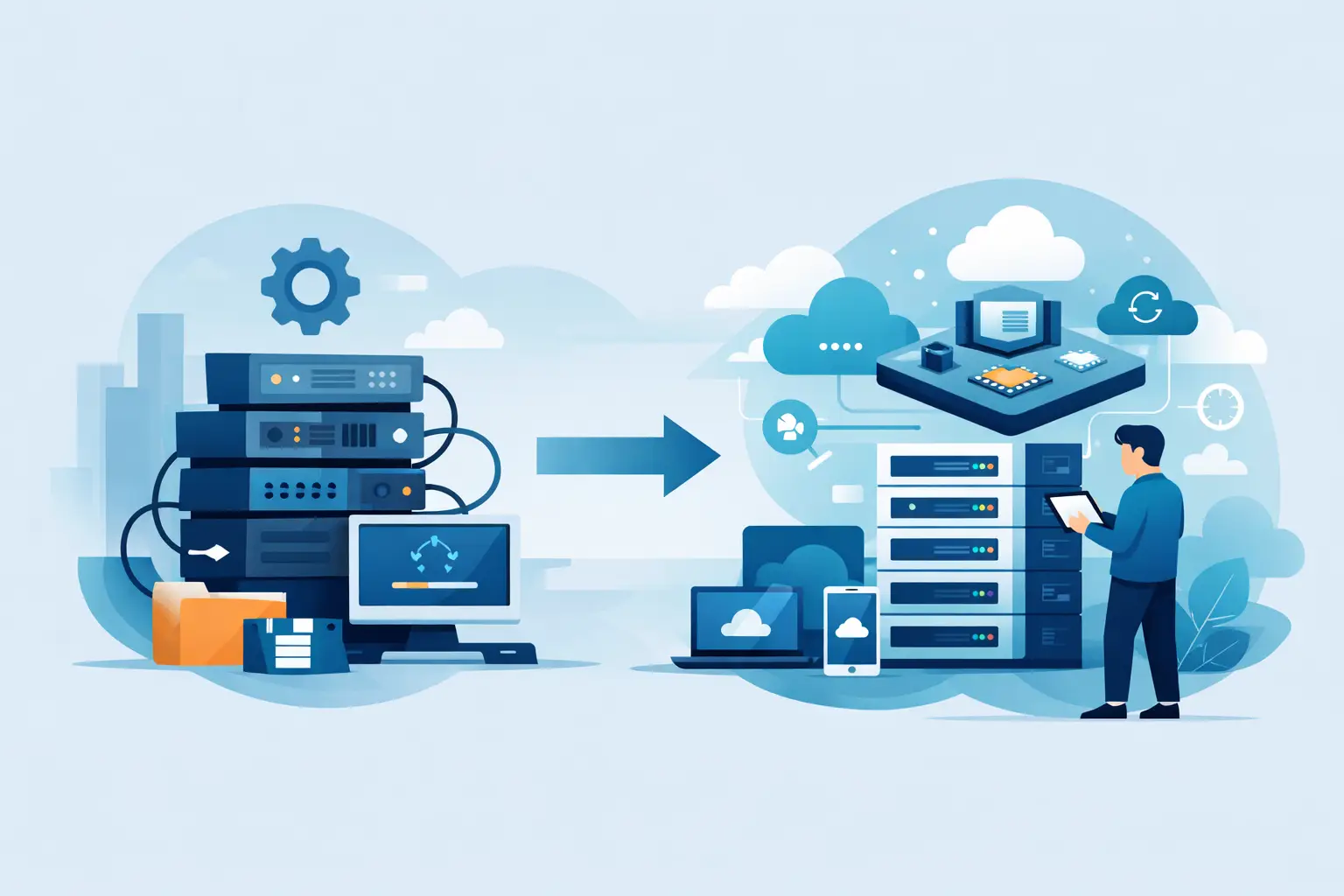
If your core system still runs the business but slows every release, inflates support costs, and turns small changes into projects, the real question is not whether to act. It is how to modernize legacy systems without breaking the operations that still depend on them.
For most companies, legacy modernization is not a rewrite conversation. It is a business continuity decision with technical consequences. The old platform may hold customer data, pricing logic, fulfillment rules, or finance workflows that nobody wants to destabilize. At the same time, keeping it untouched usually means rising infrastructure spend, security gaps, brittle integrations, and a delivery cadence that cannot keep up with the business.
The right approach is controlled change. Not a dramatic replacement. Not endless patching. A program that reduces risk while improving architecture, delivery speed, and operating cost.
What legacy really means
A legacy system is not just old software. It is software that has become expensive to change. Sometimes that is because it runs on outdated frameworks or unsupported infrastructure. Sometimes the codebase is tightly coupled, undocumented, and shaped by years of quick fixes. In other cases, the system itself still works well enough, but it blocks cloud adoption, DevOps workflows, security controls, or new product development.
That distinction matters. Age alone is not the problem. Friction is the problem.
A stable internal application written ten years ago may need only targeted refactoring and better deployment practices. A heavily customized monolith tied to aging databases, manual releases, and privileged access patterns may need a much deeper intervention. If you treat both cases the same way, you either overspend or under-fix.
How to modernize legacy systems without creating new risk
The strongest modernization programs start with analysis, not architecture diagrams. Before changing code, map the system in business terms. Which workflows generate revenue? Which dependencies are undocumented? Which teams rely on exports, scripts, or manual steps that no one has formalized?
This phase is often skipped because leaders want momentum. But modernization without discovery is where costs spike. Teams start rebuilding interfaces while hidden downstream processes continue to rely on old fields, old job schedules, or old assumptions. Then the project shifts from improvement to emergency response.
A practical assessment usually covers five areas: application architecture, infrastructure, data model, security posture, and release process. You are trying to answer a simple set of questions. What must stay stable? What creates the most drag? What can be isolated? What can be retired?
Once that picture is clear, choose the modernization pattern that fits the system.
Pick the right modernization path
There is no universal playbook. Most organizations end up using a mix of strategies.
Refactor when the business logic still has value
If the application encodes years of rules that are still correct, refactoring may be the smartest path. That means improving code quality, breaking tight coupling, adding tests, and separating components so the system becomes easier to change. You preserve what works and remove the barriers around it.
This path works well when the core logic is valuable but the delivery model is outdated. For example, a business-critical platform might stay functionally similar while moving to containerized workloads, automated CI/CD pipelines, and better observability.
Replatform when the application is fine but the environment is not
Sometimes the software is not the main issue. The issue is where and how it runs. Moving an application from aging on-prem infrastructure to AWS, replacing manual deployments, and tightening identity and access controls can remove a large share of the operational risk without changing every line of code.
This is often the fastest route to measurable gains. Better reliability, lower infrastructure waste, easier backup and recovery, and stronger security controls can all come from platform changes alone. It is also where cloud cost optimization matters. A rushed migration can trade one problem for another if usage, scaling rules, and storage patterns are not designed carefully.
Rebuild only when the current model cannot support the future state
A rebuild makes sense when the legacy architecture fundamentally limits the business. Maybe the system cannot expose APIs cleanly, cannot meet security requirements, or cannot support modern product workflows without constant workarounds. In that case, rebuilding selective domains may be justified.
The key word is selective. Full rewrites fail when they treat the old system as disposable before the new one has proven itself. Safer programs replace capabilities in phases, validate them in production, and retire the legacy footprint gradually.
Start with the parts that hurt most
One reason modernization stalls is scope. Companies try to fix everything at once. A better approach is to identify the highest-friction areas and use them to set the sequence.
That might be the reporting module that depends on fragile batch jobs. It might be authentication that no longer meets security expectations. It might be an order-processing path that takes weeks to modify because logic is scattered across the codebase and database procedures.
Prioritization should balance business value and technical feasibility. The ideal first target is painful enough to matter but contained enough to deliver progress quickly. Early wins build confidence, but they also reveal the operating realities of the broader program.
Data is usually the hardest part
Code gets most of the attention. Data causes most of the risk.
Legacy systems often rely on schemas shaped by years of exceptions, duplicated records, and application logic hidden in stored procedures or export routines. If you modernize the application layer without addressing data quality, data ownership, and migration sequencing, the new platform inherits the old problems.
Treat data modernization as its own workstream. Define canonical models where possible. Audit integrations that read from the database directly. Identify retention and compliance requirements early. If a phased migration is planned, design synchronization carefully so old and new systems do not drift.
This is also where software auditing pays off. A disciplined review of code, dependencies, workflows, and data handling often surfaces hidden coupling that would otherwise appear late, when change is expensive.
Security cannot be postponed
Many legacy platforms were built before current expectations around access control, secrets management, auditability, and vulnerability management. Modernization is the right time to correct that, not the time to copy old weaknesses into a new environment.
A proper security audit should look beyond obvious issues. Review service accounts, deployment paths, dependency health, network exposure, encryption practices, logging, and privilege boundaries. If the system is moving into cloud infrastructure, define identity models and policy controls before migration, not after.
Security work can feel like it slows delivery. In practice, it prevents rework. Retrofitting access models and controls after a system is already moving is usually more disruptive than designing them from the start.
Delivery model matters as much as architecture
A modern application still behaves like a legacy system if releases are manual, testing is inconsistent, and environments drift. This is why modernization should include the software delivery lifecycle, not just the codebase.
CI/CD pipelines, infrastructure as code, environment standardization, rollback planning, and observability are not side improvements. They are part of the operating model that keeps the new system maintainable. Without them, teams carry the same old dependency on a few specialists who know how to deploy, patch, or recover the platform under stress.
For many organizations, this is where DevOps work creates immediate leverage. It reduces release friction, improves traceability, and gives decision-makers a clearer view of system health. Modernization is not complete until delivery becomes repeatable.
Measure progress by outcomes, not activity
If the only metric is code migrated or services deployed, the program can look busy while delivering little value. Better measures are tied to business and operational outcomes: deployment frequency, incident rate, lead time for change, infrastructure cost per workload, vulnerability exposure, and the effort required to implement a common feature request.
Those metrics help separate meaningful progress from architectural theater. They also make trade-offs easier. A system that is 80 percent modernized on paper but still requires weekend releases and emergency fixes is not actually modernized.
Expect a hybrid state for longer than you want
Most companies will run legacy and modern components side by side for a period of time. That is normal. The goal is not to avoid the hybrid phase. The goal is to control it.
Define temporary interfaces clearly. Limit how much new logic is added to the old platform. Set criteria for decommissioning. If you do not, the hybrid model can become permanent and create a new layer of complexity instead of reducing the old one.
This is where restraint matters. Clean execution beats ambitious scope. A focused program that modernizes critical flows, strengthens security, improves deployment, and lowers infrastructure waste will outperform a larger program that tries to transform everything at once.
For teams asking how to modernize legacy systems, the best answer is usually less dramatic than expected. Start with evidence. Reduce coupling. Fix delivery. Audit security. Modernize the platform where it creates leverage. Rebuild only where the business case is clear. If you approach it that way, modernization stops being a risky bet and becomes a controlled upgrade in how the business operates.
The useful next step is not a rewrite plan. It is a precise assessment of what your current system costs you every month you keep delaying change.